The Accordion and the Human Being Are Very Similar – They Breathe the Same
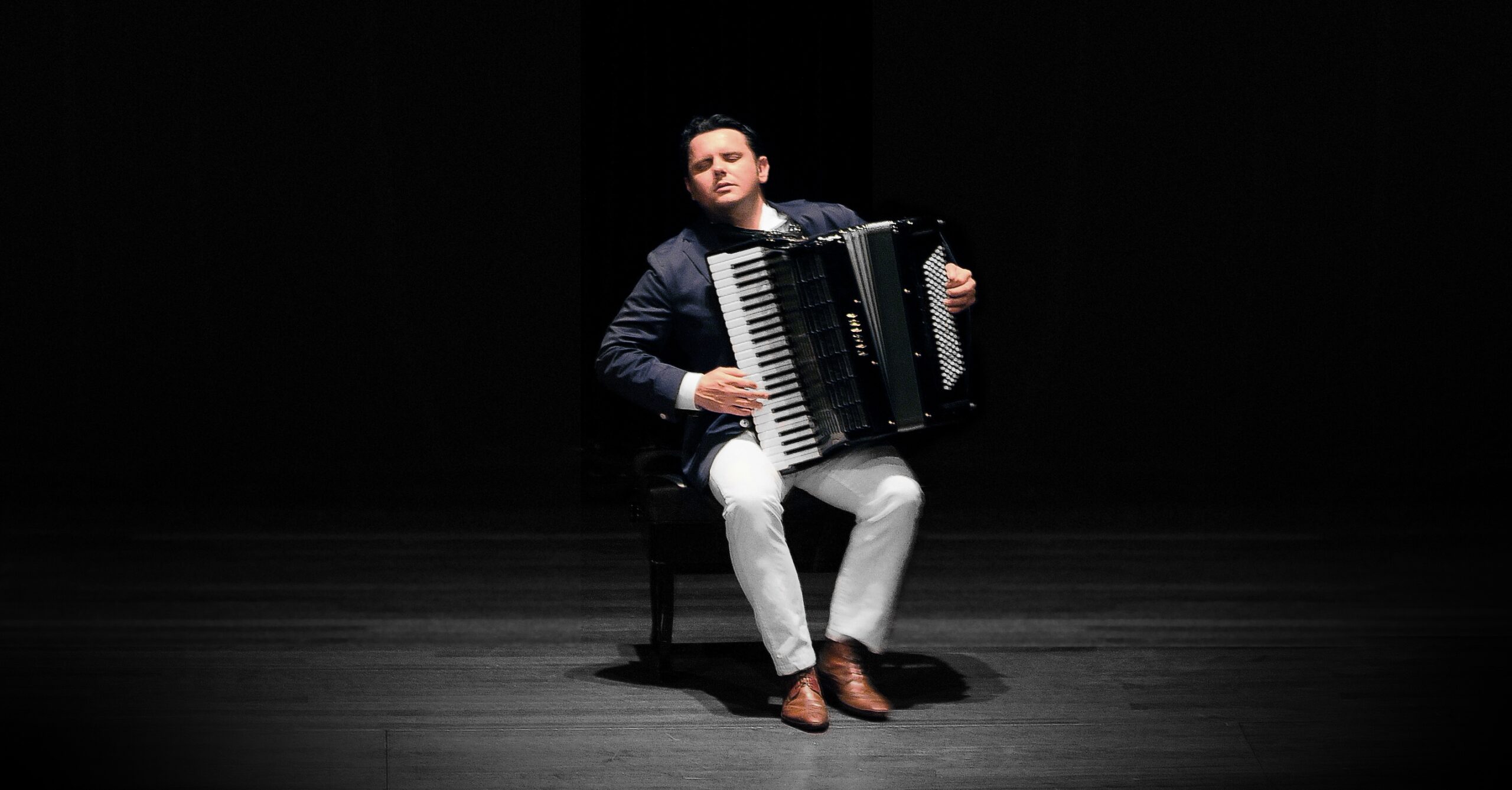
Nihad Hrustanbegović | Photo: Willem van Walderveen
A conversation with Nihad Hrustanbegović, a Dutch-Bosnian classical accordion maestro and composer, comes after an extraordinary artistic endeavor — seven consecutive nights at London’s Royal Albert Hall, as part of the Teenage Cancer Trust program, at the invitation of Robert Smith.
With these performances, Hrustanbegović wrote new pages in musical history, becoming the first accordionist to achieve such continuity in the iconic London hall. In a space that includes top-notch production, but also a strong emotional exchange with the audience, he shaped performances that transcend the boundaries of genre and instrument, confirming the accordion as a contemporary concert voice capable of dialogue with different musical worlds.
His artistic path has spanned a wide range for years — from interpretations of canonical works to original compositions that combine classical tradition with elements of jazz, flamenco and sevdah. This performance at the Royal Albert Hall represents for him not just another concert reference, but a turning point and a return to a more intense performance rhythm.
For Urban magazine, Hrustanbegović speaks of the seven nights at the Royal Albert Hall as a unique experience in which the stage, the audience and personal transformation intertwine — from meeting Robert Smith and the dynamics behind the scenes of one of the most prestigious concert venues in the world, to reflecting on his own musical language that blurs the boundaries between classical, rock and improvisation. He also raises the question of how the accordion in his expression becomes an orchestra in one body, and how the freshness is not lost in the continuity of the performance, but rather the perception of the music, the space and himself changes.

Seven consecutive nights at the Royal Albert Hall is not only a technical undertaking, but also a physical and mental challenge. What happens to the artist in that continuity — between the first and the last night?
There is a total focus — from the morning until the beginning and end of the performance. Considering that it was seven nights in a row, there was something new every night. I enjoyed getting to know everyone I met at the Royal Albert Hall. I behaved like I was in the first grade of primary school — everything according to the rules. I have never worked with bigger professionals: from the production, where over 100 people were engaged, to all the artists I met. I even avoided going for a drink with one of the star singers (laughs), so I only went to the after party on the seventh night, which was organized every night for the participants and VIP guests at the Artist bar. After the second night I became a regular post-show guest on center stage, in Robert Smith’s box, along with his friends, bandmates The Cure and his wife Mary. The audience was like one, and every night I played from zero to hero — from the moment the doors open and the audience enters, until the moment when there are about 5,000 people in the hall. Sometimes there would be screams and shouts when I played something that particularly excited them. When I “turn on” the distortion on the harmonica and it sounds like a guitar… I’m kidding, of course, but that’s pretty much how it was. For the most part, believe it or not — it was peaceful. The atmosphere and ambiance in the most beautiful hall in the world leave you breathless, and breathing is very important then. How do I come here…
Behind me are performances for Queen Beatrix of the Netherlands, Knight’s Hall in The Hague, Concertgebouw Amsterdam, the album The Best of Concert Accordion, which changed the perception of classical accordion in the Netherlands, because the combination of classical, modern and personal compositions with pop, jazz, Balkan, flamenco and sevdah elements was strongly recognized by a wider audience. The composition “Promenade of the World” became the soundtrack for the Heineken Extra Cold TV commercial, which was seen by millions of viewers and broadcast on all television channels. This was followed by performances with Grace Jones and Al Di Meola, music for films in Switzerland, Italy, the Netherlands and Bosnia and Herzegovina, as well as Vivaldi’s “Four Seasons” and the tenth album Mediterraneo. I haven’t performed that often in the last ten years, because at one point I got fed up with it all and lost inspiration after “Four Seasons”. I came to a dilemma about what to do next after the musical description of life and nature. However, it seems that it can — and apparently I am happy again when I play, and that is perhaps the essence of my life. Mediterraneo. Music. And life in the present, not in the past. A reset has occurred in the year 2024.

This performance comes at the invitation of Robert Smith. How important was that trust for you — and what do you think he recognized in your expression?
In art and the concert scene of the world, the rule is: expect the unexpected, and in music theory what is written — is written. In life, you obviously need to have guts, so dare to touch art that is “untouchable”. And a dead letter on paper in music theory can spin endlessly from hollow to empty. What did he see in me… he saw the program from the concert on Brač during Janez’s days and in that program he saw who I was. I think he recognized in me an artist who knows his way around many artistic genres and who expresses respect for him, for art, but also for other artists. I played on Brač in the summer of 2025, at the invitation of the Croatian academic sculptor Sandra Nejašmić Pirnat, in the SanJan gallery in Postira, where Robert Smith has been a patron for the past few years, because the sculptural work Bagatelle by Janez Pirnat was chosen for the cover of the album Songs of a Lost World by the band The Cure, which was released on November 1, 2024. I didn’t meet him then because he didn’t come to Janez’s days, but the program got to him. Well, that program took me to the Royal Albert Hall, and Robert’s will and God’s will, and all the effort I put in during the preparation and practice of that concert and performance.

For me, it was a big shock to be called by someone I had been listening to and studying intensely for the past year, and at one point I realized what a real star is and what kind of seriousness it is where the burden of fame is simply no longer a burden. There is a certain barrier between classical and pop music that I have overcome — because, for example, Vivaldi is baroque, and Robert Smith’s band The Cure actually started with a pop punk rock style and then moved on to gothic rock pop. The Cure’s music has appeared in at least 12 films. Regardless of the fact that I am interested in both classical and modern music, at one point I started studying gothic rock pop because I was interested in the sounds and agogy of that genre, but also how to remain an artist when you become a star — or you were already one and got bored, or when you actually become mature, an adult as a person in art. That is why Robert Smith is the greatest living artist for me. Robert is also a painter. That is what really interests me, but also the fact that he has been with his wife since his teenage days until today. I love that harmony, timelessness and loyalty.
When I met Robert in London, I saw that he is someone who is a total multitalent — not only as a composer, singer, guitarist, but also in relation to everything around him, and to people. Balance. Human. A great authority on the British pop rock scene and in the world, if not the biggest, in recent years. They love him very much, and he deserved it. His wife was also present during the Teenage Cancer Trust at the Royal Albert Hall. A wonderful woman. Mary Poole. Dedicated to her husband in a way that is called, in every respect, harmony and support. Meeting and hanging out with Robert was simply spectacular — starting from the first contact, when he expressed his desire to come play and introduced himself as a fan of mine, to the moment when we were both laughing, happy that the concert week for Teenage Cancer Trust is going phenomenally and spectacularly. One evening I skipped Vivaldi, so he asks me: “Did you play Vivaldi tonight?” — I didn’t, I played your compositions and mine.

Critics describe you as “an accordionist with the soul of an orchestra.” Did you consciously build that sound — or is it the result of a long process of searching for your own language?
Yes. It has been developing in me since the Academy of Music during my student days. I wasn’t that aware of it, but when I was preparing the album “Four Seasons” in 2014, I became totally aware of it. The concert classical accordion as an instrument has 15 registers on the right side and at least 4 on the left. This in itself gives different colors, so to speak, to the instruments, but it is not even close to nor does it imply that changing the register automatically gives you a different instrument. So, when 3 or 4 lines are really played with touché — a specific way of touching the tones and compressing the accordion bellows — then they sound like 3 or 4 different instruments at the same time and give the accordion a symphonic sound and character. Literally, each line has its own trajectory and life, articulatory and agogic, and together they create harmony and a whole. So you get the sound of, for example, bass, cello, alto violin and violin at the same time. Of course, depending on the style, there are also organ sounds, then the harmonica and instruments with holes like the piano.

The accordion is often perceived through very narrow genre frames. Do you feel that you have permanently shifted that perception with these performances — or is the struggle to redefine the instrument still present?
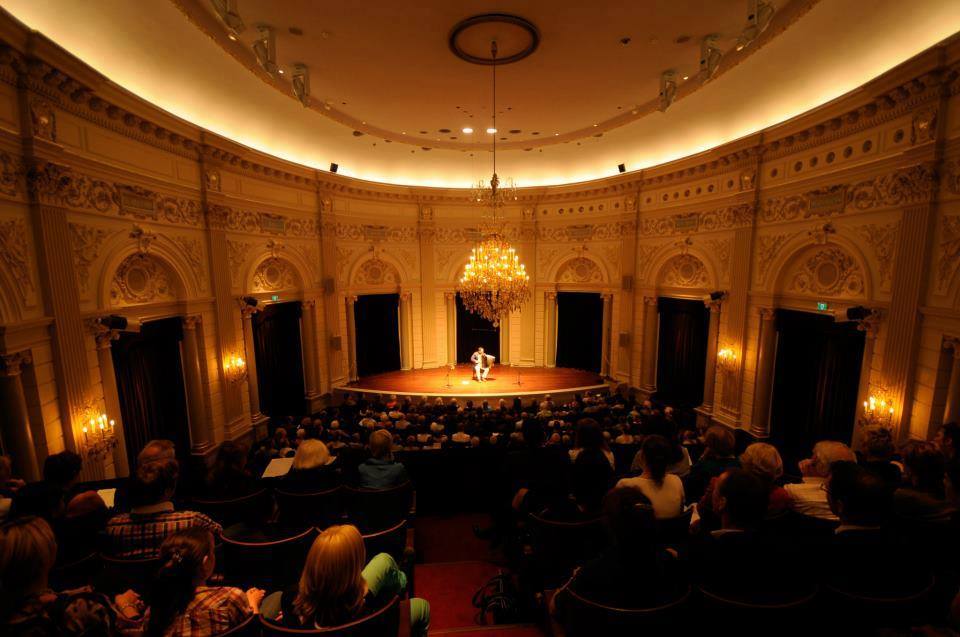
In the real world of art, there is no vanity, but only joy, love and happiness for someone’s success and work — order, work and discipline. What is most important is that the composition I play or the concert has life in it and that the audience goes home with positive energy, forgets everyday life and understands that the point of life is love and human unity through music. Recharging the batteries. I play, practice, study and go on stage to create the art of sound and composition and convey that experience to the audience. There were several phases in my life where it was a challenge, for example, playing in the Concertgebouw in Amsterdam — that was complicated to achieve — but also other halls where I had a great pleasure playing: Dom Armije in Sarajevo, the Cathedral in Sarajevo, Notre-Dame in Le Puy-en-Velay in France. Historical places with acoustics are very inspiring to me. Ultimately, acoustics are my greatest inspiration. Then the tones become infinite.

Over the course of seven nights, you went from Antonio Vivaldi to The Cure. How do you approach that breadth — is it an adaptation or a unique expression that connects all these genres?
There is no unique expression. A person can be unique, but so can a situation. Let’s say that I was constantly on the stage at the Royal Albert Hall relaxed, enjoying myself non-stop and happy to be where I am. Each composition requires its own emotion, character, playing technique and harmony. The final result can be unique.

Your repertoire also includes works such as “Libertango” by Astor Piazzolla and “Yesterday” by The Beatles. When you interpret such famous compositions — where does the original end and your version begin?
The original is in melody and harmony, and my version begins when I allow myself to re-compose it — even during the performance itself — or improvise in accordance with the original. Although it is quite possible that it will become a completely different composition.
In the description of your performance, the word “breathing” often appears — as if the instrument becomes an extension of the body. When did you first feel that the accordion really “breathes” with you?
In order to play, it is necessary to feel the pulse, meter and tempo, and therefore to breathe through playing. Making a sound on an accordion also requires breathing — opening and closing. That’s how tone is created. An accordion and a human being are very similar. I sing inside myself while I play, and that’s the connection — it’s not the instrument that’s playing, but me, and meter, rhythm, agogics and so on are added to that.

Each evening had a different dramatic flow. How important is it to you that the concert is not just a series of compositions, but an experience that has an internal narrative?
Each of those compositions is a story in itself that has its own experience. Each has its own symbolism, meaning, melody, harmony, energy, soul — gentleness, sincerity, love, togetherness, connection.

There is also a subtle echo of Balkan melos in your work. How important is it to wear one’s own background on world stages — and does it change when meeting a global audience?
I am someone who was born in the SFR Yugoslavia, in the Republic of Bosnia and Herzegovina, which has a thousand-year history since Ban Kulin, King Tvrtko and Queen Katarina. Histories have their own flows and changes. I have been in Europe since I was born, I found my identity in the Netherlands, and later the core of European culture in France. At one point, all the dynamics of history became a burden to me, so Amsterdam, Dalmatia, Sarajevo, France, and now Great Britain, mean the most to me – that’s where I have my peace.

This project had a strong humanitarian character through the Teenage Cancer Trust. How much does such a context change the relationship to the performance and the audience?
All the bands that played gave their full strength and energy. I think that was the meaning — not to pity, but to transfer the energy of life to those who are sick, to make them better, and to be there for them as musical and human support.

Performing seven nights in a row means repeating, but also starting anew every time. How is freshness preserved — so that each performance remains alive and not a reproduction?
I dressed differently every night, changing details and colors, sometimes even the suit. It was a total pleasure to play at the Royal Albert Hall every night. They combined the sound with hall acoustics and a special system — it sounded incredible. Live movie. I changed the arrangement of the compositions, inserted new ones, to avoid repetition.
Your success has been described as a “historic moment for the accordion”. Do you feel a responsibility towards the instrument — as someone who represents it on the world’s biggest stages?
First of all, responsibility towards oneself. I haven’t had a chance to do something like this for a long time. It means to me that everything that came before was not in vain and that my career still exists — and in full splendor that I have not yet experienced.

You come from an area that rarely has continuity of support for classical music at this level. What does this success mean for artists from Bosnia and Herzegovina and the region — from your perspective?
As far as I’ve noticed, many are pleased and happy. But young artists need more interaction with Europe — collaborations, projects, concerts — and not competitions as a measure. Art is not a competition. I realized this during my studies. In the world of accordion, competition winners rarely build a career outside of that circle. Art is a concert, an album, an audience, the media. There is no instant success. Talent is order, work, and discipline — and only then comes freedom of interpretation.

After such an undertaking, what remains for you as the next challenge — and is it even possible to “repeat” a moment like this?
There are moments that are unrepeatable. Performance for Queen Beatrix, Knight’s Hall in The Hague, first album, “Promenade of the World” and Heineken commercial, collaborations with Grace Jones and Al Di Meola, “Four Seasons”, concert at Notre-Dame du Puy, SFF 2020, concerts in Sarajevo, Mostar, Banja Luka, Amsterdam 750 years… and now seven times Royal Albert Hall. Further — I don’t know. Preparations are underway for the 11th album and concerts in the summer of 2026. The accordion was being tuned by Sinan Ajkunić. There are more theaters and movies.
But the bottom line is health and happiness. Last year I had a serious health problem and it changed me. I got my energy back, changed my lifestyle, lost 15 kilos. When toxicity is removed, energy comes. After that, a call came from Great Britain — as a sign. At the time, I was sitting on a bench in Sarajevo, looking at a bird and thinking about the essence of life. Today I know. I’m happy. Alive, healthy. Let’s move on.
https://www.urbanmagazin.ba/nihad-hrustanbegovic-harmonika-i-ljudsko-bice-su-itekako-slicni-disu-isto/ – https://www.urbanmagazin.ba/ 15 05 2026
When the horn blows – Nihad Hrustanbegovic – Accordion – Royal Albert Hall -Teenage Cancer Trust
https://youtu.be/0tTgVOAuzY8?si=TeSjrd09h09rkDp2